

The Future of EU5 - Grand Voyage Roadmap
Date: 2026-05-04 15:05:31
Today, we share our Grand Voyage.
Hello everyone, I'm Ryagi, Community Manager at Tinto, and joining me is EU5's Associate Game Director David, and the one and only Johan, Studio Manager at Paradox Tinto.
Back in 2024, we revealed project Caesar with Tinto Talks #1. That's where Johan first shared the core pillars that would define EU5. Believable World, Setting Immersion, and Replayability. Everything we do is still within these pillars, and the game has grown, evolved, and been genuinely shaped by you, your feedback, your passion, and your vision for what EU5 could be. Our players have always been part of the development Journey, and today is our chance to give you some insight into the voyage ahead. Before we look into the future, let's start from the beginning. Here's Johan to walk you through the journey where we came from, how the design evolved, and the role this community played in making EU5 what it is today.
On the design of EU5 - From Studio Manager Johan:
[quote]
When we set out to build Europa Universalis V, we had a clear ambition: create a deeper, more systemic simulation of the early modern world than had ever been attempted. What we didn't fully anticipate was how loudly and how helpfully our community would tell us where the gaps were. Development is always a conversation, but EU5 has made that conversation unusually direct, and I think the game is better for it.
From the moment the game launched, real players brought real hours and real frustration. The feedback that came back wasn't noise. It pointed at something genuine, that the richness of our new economic and population systems needed to be matched by an equivalent richness in the human layer of the game. People didn't just want a better simulation; they wanted to feel like their nation had a story worth telling.
One of the clearest signals we received was around the historical agency. EU5 was designed from the start as a more open sandbox than its predecessor, and we deliberately moved away from scripted mission trees as the primary content delivery mechanism, trusting that emergent systems would produce compelling histories organically. The community has pushed back on this, and not unfairly. What players told us, in hundreds of forum posts and Reddit threads, is that they don't want railroading, but they do want historical paths to feel achievable, not accidental. There is a meaningful difference between forcing an outcome and making it feel within reach.
That tension between sandbox freedom and narrative satisfaction has genuinely shaped how we are thinking about content going forward. DHEs were our answer to the mission tree question, and while the underlying idea is sound, we have heard clearly that they need to be more discoverable, more consequential, and more connected to each other. Single events that fire and disappear don't feel like a story. Players want chains, arcs, moments that feel like they were built for the nation they are playing.
AI behavior has been another area where community feedback has accelerated our thinking. EU4 had a personality layer with attitudes, exposed goals, and a sense that the other rulers in the world had intentions you could read and react to. EU5 launched without this, and players noticed immediately. The conquest desire system we shipped was functional but opaque, and opacity in an AI is death for the diplomatic game. We are working on giving the AI a legible face again, and that work is directly the result of sustained player feedback.
What has changed isn't the vision; it is our understanding of what players need in order to experience that vision. A great simulation that players can't connect with emotionally isn't a great game. The community has kept us honest about that distinction, and the patches since launch reflect it. Each update has been shaped not just by internal review but by the conversations happening in the forums, on Reddit, and in the content creator community.
Looking back, the most valuable thing launch gave us wasn't bug reports; it was perspective. Players told us what they were reaching for and not finding, and that is a different kind of signal than a crash log. We are still early in EU5's life, and there is a lot of road ahead. But the shape of that road is clearer because of the people who have been playing it, arguing about it, and caring enough to tell us exactly where we got it wrong.
Now let's get into what you're really here for, the future of EU5, and everything we have in store for you.
As many of you already know, we announced our first three DLCs ahead of launch. Fate of the Phoenix Immersion Pack, Across the Pillars Chronicle Pack, and The Auld Alliance Chronicle Pack. All of these DLCs are included with the Premium Edition. This means if you already own the EU5 Premium Edition, all three unlock automatically when they release.
But, DLCs alone do not paint the full story for the voyage ahead. Some of our most commonly requested features and changes come with free updates. And many of you have asked us for a clearer picture of where EU5 is headed. That's exactly what today is about.
So without further ado, here is our Grand Voyage Roadmap:
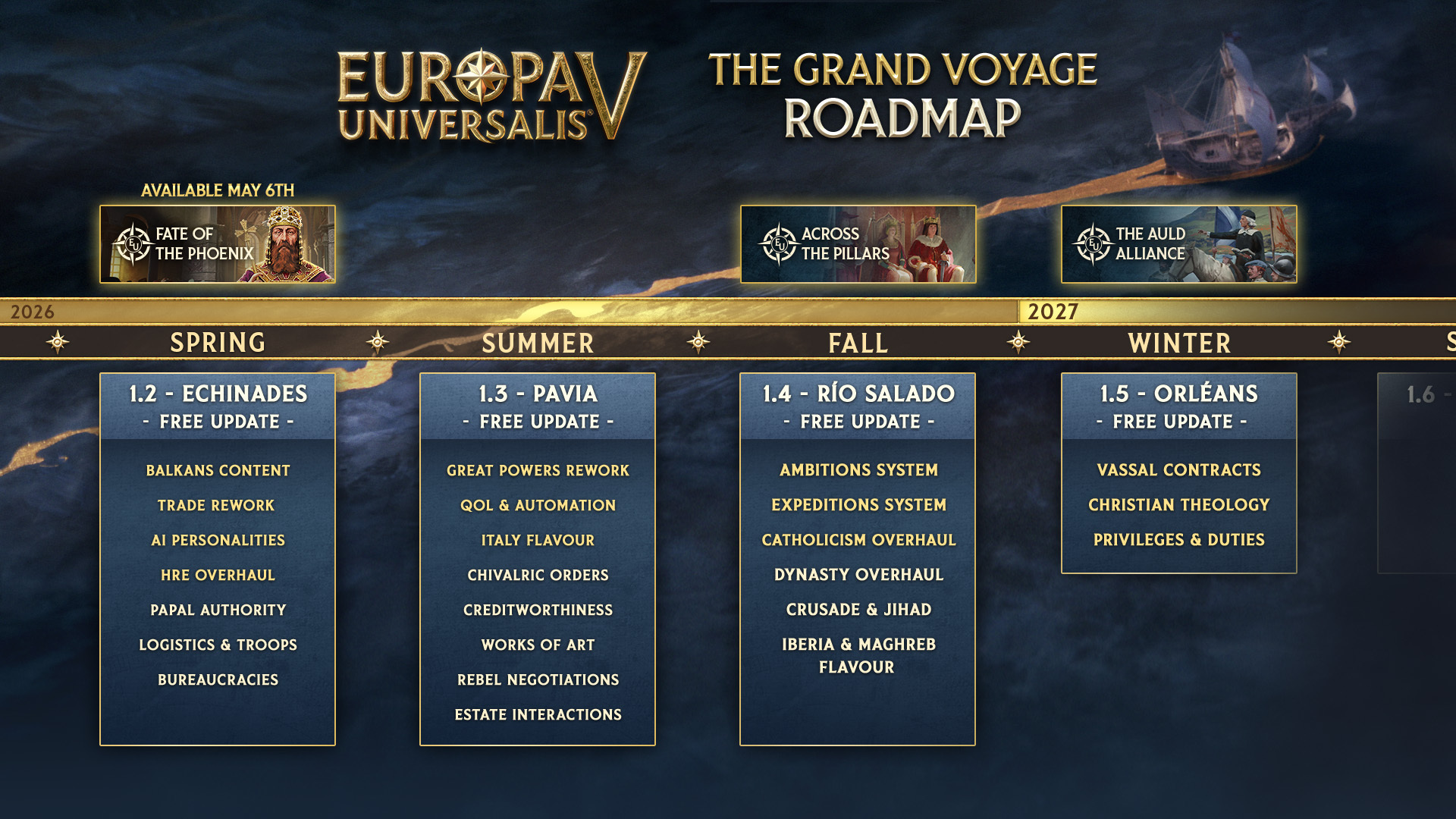
Below you can find some extra details what our goals are with each of these upcoming updates, keep in mind these are subject to change:
Update 1.2 - Echinades:
We wrote about the mechanics changes during three Tinto Talks during April, and the changes touch your cities, your armies, your cabinets, and, perhaps most importantly, the eternally chaotic Holy Roman Empire.
The big economic addition is Urban Rights, legal privileges you grant to towns and cities to shape their economic identity. Towns get one slot, cities get two, and capitals get a bonus.
There's a solid regional flavor here: German cities get Magdeburg or Nuremberg Rights, Iberian ones get Fueros, Scandinavian ports get Fishing or Bergslag privileges. Most rights strip on conquest, so freshly taken cities don't just hand you their economic legacy.
The new Trade Orders system lets you set import/export directives and let the AI handle routing, cheapest sources, and best markets, automatically. Priority order matters when capacity is tight, and unprofitable orders just keep retrying rather than disappearing.
On the military side, infantry and cavalry now have a proper light/heavy split. Light infantry moves faster and acts first, but deals less damage and takes extra morale hits. Heavy infantry is slower, penalty-free, and the only type that can garrison forts. Cavalry follows the same logic, light horse is blazingly fast with great flanking but fragile; heavy cavalry is sturdier and more of a specialist pick as gunpowder takes over. A new Siege Raider stance is built for vassal armies: siege everything, avoid field battles, run when caught.
The HRE gets a real facelift. The Diet UI is now tabbed (Overview, Members, Treasury), and voting is actually readable; tooltips show projected outcomes before you call a vote. The new Imperial Armory building gives Emperors a real military tool, funneling local manpower to imperial forces or providing direct recruitment on home territory.
The terrain system got a thoughtful pass too: your capital's terrain type now reduces the proximity penalty for that same terrain by 20%, and mountain cultures like Scotland, Switzerland, and Nepal have dedicated advances for it. Terrain penalties are now multiplicative, so they stay meaningful even when you stack infrastructure bonuses.
Characters are a bit more interesting now, with health traits representing their physical wellbeing (or lack thereof). Commanders can receive serious injuries in bloody battles. They can also gain cabinet traits which allows you to specialise your cabinet beyond simply going for the best ability score.
_______
Update 1.3 Pavia:
This update delivers a sweeping set of changes to Europa Universalis V across systems ranging from economy to diplomacy to military. The Great Power system has been redesigned around area dominance rather than a score formula, with a new Regional Power tier sitting between being a minor nation and full Great Power status. Estates have their own culture and religion independent of the crown, and estate interactions have been expanded with eight new emergency options letting players trade long-term goodwill for immediate wartime relief. Reformation spread will be handled by the Movement system rather than a manual script loop, making it more organic and historically grounded. In 1.3, Rebel factions can be negotiated with directly before they revolt, and fort loyalty during rebellions will depend on local conditions rather than being automatic.
On the economic side, profit margins for production buildings in 1.3 have been significantly cut, making them genuine investment decisions rather than passive money printers. A new establishment mechanic means newly built production buildings ramp up slowly based on local literacy, disadvantaged by late arrivals against historically rooted industries. Price elasticity has been introduced so that expensive goods genuinely suppress demand, allowing regional trade imbalances to persist and giving trade routes lasting purpose. Mills have been overhauled to be cheaper, faster to build in cities, and more competitive in the late game. Ten historical regions have gained static production bonuses reflecting their real-world economic legacies, from Flemish cloth to Venetian glass.
The naval balance pass gives heavy ships meaningful penalties in enclosed seas and straits, making galleys a genuine strategic choice for Mediterranean-focused empires. Military orders have been capped on sponsors and tightened on passive income to prevent them from outgrowing their patron kingdoms. Roughly thirty cost modifiers have been converted to efficiency modifiers with diminishing returns to curb runaway min-maxing. Several new automation tools have been added, including split cabinet controls, per-building auto-expand flags, and fine-grained automated diplomacy toggles. Rounding out the 1.3 update, Government Bonds, Imperial Circles, Independent Operations for armies, and a Creditworthiness system each add new strategic depth to their respective domains.
_______
Update 1.4 - Río Salado:
The focus of this update is a pair of transformative core features: a deeper sense of national aspiration and far-reaching journeys of discovery.
A new system for Ambitions will allow you to articulate your nation's long-term goals to the world, creating dynamic rivalries and diplomatic tension as other powers react and contest your path to greatness.
With Expeditions, we are adding immersive narrative depth by allowing named characters to undertake monumental journeys, complete with unique event chains and consequential outcomes that will shape your nation's history.
The Dynastic experience will be receiving a significant injection of depth, providing new tools for securing alliances, arranging successions, and managing shared power arrangements that will enrich the political landscape.
We also plan to introduce more surgical options for Economic Warfare, giving players fine-grained control to pressure rivals or strengthen allies through focused trade policy. Camels will make an appearance as trade goods, alongside Camelry levies. Catholicism will receive a pass to make Cardinals more interesting, and we will rework the Crusade system.
The features are designed to harmonise with Across the Pillars, our first Chronicle Pack, which is releasing around the same time. It will explore the narrative that unfolds between Castile, Morocco, and Granada, while adding plenty of exciting content for them in the early game.
_______
Update 1.5 - Orléans:
While the DLC is planned around France and the Western European state of the 15th–16th century, there are quite a few mechanics we aim to address in this update. More mechanics for the building-based countries, like Trade Companies and State Banks. Pop needs will be split into life needs, everyday needs, and luxury needs, which have different consequences.
Estates will generate self-serving spending requests that give them a distinct economic identity, and estates under enemy occupation during wartime will become significantly harder to manage. Peace-making is something we plan to rework into a more bilateral negotiation where both sides put demands on the table, funded by their own warscore, so wars end with both parties gaining something rather than one side simply dictating terms.
Subject relationships are planned to gain a contract layer where overlords and subjects can negotiate individual clauses covering loyalty, building rights, and war obligations, making vassal management feel more like genuine statecraft.
Christianity as a whole will get a rework, allowing more natural schisms and mendings along theological lines.
These themes are with our second chronicle pack, Auld Alliance, which will also release around this time. It will be focused on content and gameplay for France and Scotland, and in particular, the Hundred Years' War.
_______
Update 1.6 and Beyond:
Beyond these updates, we have further plans for new Bookmarks, better Horde gameplay, and more…
We’re excited to bring these features to life, and we mean that, because none of this happens without you. Please continue to give us the feedback and suggestions as you have been doing, so we can continue to expand this ambitious game into something even better!
The Voyage is just getting started. Thank you for being a part of it, and remember…
Be Ambitious!