

Dev Diary 4 — The Two Types of Dice in Battlemarked
Date: 2025-08-14 19:00:55
Gather ‘round, ye adventurers brave, for we have tales to tell. Let the inn’s fireplace warm you, drown out the noise of the taproom, and lend me and mine guest your audial receptacle. While it would be your greatest pleasure to hear me recount this eve’s tale, I merely stand before you today to present another to regale you with their own tale. So let us not delay, welcome them to the stage!
Greetings Adventurer, and thank you to the host for such a… colorful introduction.
We have seen many comments and questions regarding the dice and how they will work in Demeo x Dungeons & Dragons: Battlemarked and today we’re going to give you some insight into how we handle different scenarios in Battlemarked.
Why not just use a standard d20?
The goal from the beginning for Battlemarked was not to be a replacement or substitute for virtual tabletops or the classic pen-and-paper experience, but still maintain the satisfaction of controlling miniatures on the battle map and manually rolling dice to resolve attacks and skill checks. By using the Demeo Action Rolepaying System, we are able to simplify combat to be easily understood by anyone so as to allow the cooperative, tactical gameplay to take center stage as you play through the adventures.
Demeo Dice vs the Standard d20
To try and reduce confusion, we will refer to the Demeo-style d20 as the “Demeo die” or “combat die” while the numbered version we will simply call “d20” as this is what a large number of people will be familiar with.
Demeo Die (Combat Die)
For the uninitiated, Demeo uses a distilled system of Miss, Hit, and Critical Hit for the results of the combat die — represented with a skull, a single sword, and two crossed swords respectively. This provides clarity to all players across the board as to the result of the attack roll without ambiguity. Additionally, the original Demeo die was 12-sided, whereas Battlemarked will use a 20-sided version. For all intents and purposes, however, the system functions the same as Demeo and aims to bring a more streamlined approach to combat pacing.
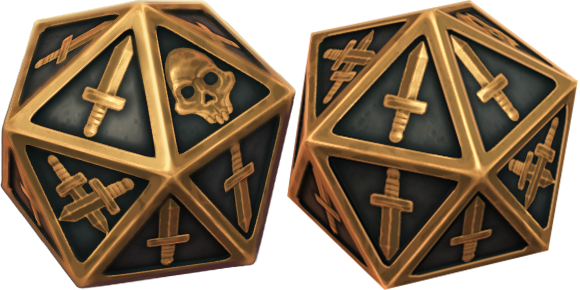
For those of you who take particular interest in probability and the crunchier side of statistical analysis, the faces are:
- Two skulls (Misses)
- Three crossed sword (Critical Hits)
- The remaining 15 faces are the single sword (Hit)
d20 (Skill Die)
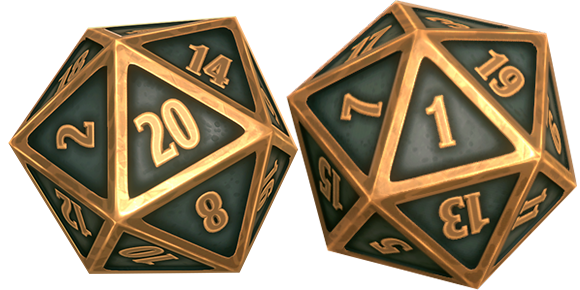
Outside of combat, Battlemarked utilizes the regular numeric version of the d20 that tabletop roleplayers are familiar with. These checks have a target Difficult Class (DC) that you need to hit in order to succeed, just as you would expect from such a skill check.
Stay tuned for our future dev diary where we will look deeper under the hood of how the skill checks work and how your character progression choices affect the final result of said checks. Until then, we hope that this has helped clarify the mechanics of the dice and gives a little more insight into our design approach.
See you in the next one!
—The Battlemarked Team
Remember to wishlist and follow us to get the latest news here on Steam as they're posted!